


What is a Buddhist Necklace?
What does it mean when we call a necklace a "Buddhist necklace"? Does it mean that the necklace depicts the Buddha? In fact, the answer is both yes and no. To begin with, "Buddhist necklace" is a broad term. Some people use it to describe a necklace that depicts the Buddha. Others use it to describe a necklace that features any Buddhist image, symbol or mantra.
Images of the Buddha are among the most commonly used in Buddhist necklaces. Others feature symbols, such as the lotus flower or the Wheel of Dharma. Buddhist necklaces may also include mantras, such as Om or Om Mani Padme Hum.
In this blog I will use the term "Buddhist necklace" broadly. In other words, I'll use it to cover necklaces that depict the Buddha, Bodhisattvas, Buddhist symbols, and mantras. Furthermore, for each of these necklaces I will go over their meaning and benefits. Last but not least, I will also cover how they can aid you in meditation, yoga, and mindfulness practices.
What is the History of Buddhist Necklaces?
The history of Buddhist necklaces flows like an ancient river. It carries the wisdom of the Buddha across time and space. Put simply, these talismans have long served as vessels for transmitting the Buddha's teachings. Even today, they continue to do so.
The origin of Buddhist necklaces dates back over 2,500 years, to the time of the Buddha himself. Some of the earliest forms were simple stone pendants found in the ashes of his cremation. Back then, to have even a tiny shard was to hold infinite wisdom in the palm of your hand. His followers would wear small relics around their necks, such as gemstones. Wearing these relics helped them feel closer to his enlightened essence.
After the Buddha passed away, it wasn't long before Buddhism spread to all corners of Asia. Indeed, it spread like wildfire. It engulfed Asian cultures with a new and profound way to celebrate spirituality.
Consequently, Buddhist necklaces took on a life of their own. In Tibet, artisans inscribed the Om Mani Padme Hum mantra on them. In Thailand, they etched images of the Buddha in meditation. Meanwhile, in China, they incorporated jade and filigree metalwork into them. Yet their purpose remained the same. They reminded the wearer of the wisdom of the Buddha and brought tranquility of mind and body.
The history of Buddhist necklaces is the history of the spiritual journey that we all share. Their beauty lies in how they hide profound truths in the simplest of forms. They cast the light of the dharma into the deepest reaches of the self.
What are Buddhist Necklaces Made of?
Buddhist necklaces are sacred ornaments. Through their symbols and depictions, they reflect the deepest truths of existence itself. With this in mind, their materials are not mere metals and stones, but carriers of meaning. Each one whispers of mysteries that pierce the veil of the ages.
- Silver is the color of serene moonlight. With its luminous sheen, it purifies the soul and awakens the mind.
- Copper is warm, like the glow that lingers in the sky after sunset. Its healing warmth kindles the spirit's radiance.
- Gemstones hold the colors of the rainbow, light slowed down into stone. They connect us with our inner light.
- Fragrant woods, like rosewood and sandalwood, carry the breath of life itself. Thus, when we breathe them in, we breathe in the fragrance of life.
In the end, every material sings the same song. Silver, copper, stone, or wood, each one rests against the heart as a quiet reminder of the Buddha's wisdom.
What is the Buddhist Necklace Meaning?
The meaning behind a Buddhist necklace opens like a secret window. It allows us to peer into the deepest recesses of our souls. In doing so, we can unearth profound insights about the true nature of everything. Like a still pond that reflects the vastness of the sky, each one tells a story of our spiritual journey. Each one reveals the lessons we've learned and the serenity we've attained.
Buddha Necklace Meaning
The Buddha is like an eternal light that illuminates the path to enlightenment. To wear his noble image is to bask in the radiance of his wisdom and compassion. Because of this, a Buddha necklace serves as a reminder of the awakened nature within us all. Each glance at his smile stirs the seeds of insight. At the same time, it teaches us that suffering arises from attachment to our desires. Therefore, it is through letting go of our craving that we can find liberation.

A 999 silver Buddha pendant, a reminder of the awakened nature within us all.
When you adorn yourself with a Buddha necklace, you open your heart to his teachings. During meditation or yoga, his presence calms your restless mind and guides you into a deep state of flow. Visualizing his form as you practice allows you to peer into your true nature.
In daily life, noticing his pendant around your neck helps you to pause and reflect. Over time, it reveals how attachment to views and expectations breeds discontent.
There is more to say about the Buddha than this section holds. For the complete Buddha pendant meaning, we've written a separate guide.
Buddhist necklace meaning: Serenity, awakening, and the path of the teacher.
Guanyin Necklace Meaning
Guanyin is the bodhisattva of compassion. She is like a luminous moon that illuminates the darkness of suffering in the world. To wear her image as an ornament is to invite her radiant light into your life. As a result, a Guanyin necklace becomes an emblem of the compassion that dwells within each of us. Each glimpse of her gentle smile awakens your capacity for mercy towards all beings.

A jade Guanyin pendant, her serenity carved in stone.
When you drape her necklace over your heart, you open yourself to her blessings. In meditation and yoga, her graceful presence soothes your scattered thoughts. Envisioning her form as you breathe eases you into a state of deep peace.
Throughout the day, the touch of her pendant against your skin helps to shift your mood. It quietly broadens your perspective.
Her mercy deserves more than a single section. So, for the complete jade Guanyin necklace meaning, we've devoted an entire guide.
Buddhist necklace meaning: Mercy, protection, healing, and boundless kindness.
Laughing Buddha Necklace Meaning
The Laughing Buddha is Budai, a wandering monk whose joy became legend. He is like warm sunlight on a spring day. To adorn yourself in his image is to invite boundless cheer into your life. In essence, his necklace is a symbol of the carefree spirit. Each look at his beaming face awakens your inherent delight. What's more, it reminds you not to take yourself too seriously.

A green jade Laughing Buddha pendant, an invitation to boundless cheer.
When you wear a Laughing Buddha necklace, you open yourself to his lightness of heart. In meditation or yoga, his round belly and rolling laugh melt away negative emotions. Likewise, picturing him as you practice infuses each breath with good humor.
As you go about your day, catching sight of his necklace helps you to see the joy in every moment. Little by little, your perspective widens with childlike curiosity.
And there's a reason this figure is so often carved in green stone. The full jade Laughing Buddha meaning is a story of joy meeting fortune, told in its own breakdown.
Buddhist necklace meaning: Joy, abundance, good fortune, and contentment.
Amitabha Necklace Meaning
Amitabha is the Buddha of Infinite Light, the central figure of Pure Land Buddhism. He is like an eternal flame of compassion. He lights up the darkness and guides you along the path to enlightenment. To adorn yourself with his necklace is to bask in that divine glow. Above all, an Amitabha necklace is a reminder of your true nature: infinite love, peace, and wisdom.

A silver Amitabha Buddha pendant, a bearer of infinite light.
When you wear his image, his radiance washes over you. In meditation and yoga, his calming presence steadies your practice. Indeed, tradition holds that by contemplating Amitabha, you take on his qualities.
During the day, the pendant resting near your heart awakens empathy, calm, and insight. Gradually, stress and worry dissolve. And you remember the vast radiance that shines within you.
Buddhist necklace meaning: Infinite light, boundless life, and rebirth in the Pure Land.
Acala Necklace Meaning
Acala is the Immovable One, the wrathful protector who guards the gates of inner wisdom. His fierce scowl is not anger. Rather, it is compassion in armor, turned against everything that blocks your path. To wear his necklace is to carry an invincible shield. It repels the forces of darkness and instills strength within you.

Acala pendant cast in silver, an invincible shield against darkness.
When you wear an Acala necklace, his steadfastness becomes your own. In meditation or yoga, his stern gaze stills your overactive mind. In that stillness, insight arises like the sun peeking through the clouds.
In the everyday rush, his strength helps you glide through entangled traffic and crowded supermarkets. You become the eye of the storm: untouched, yet at the same time aware of the chaos around you.
At night, his blessing smooths away the cares of the day. Finally, you drift into dreams wrapped in his protection, and each dawn you wake with Acala's poise and clarity.
Buddhist necklace meaning: Immovable resolve, fierce protection, and compassion in armor.
Vajrapani Necklace Meaning
Vajrapani is the bodhisattva of power. He is the thunderbolt-wielder who stood guard at the Buddha's side. Like a storm that clears away the clouds of ignorance, he reveals the vast open sky of your mind's true nature. To wear his necklace is to call upon his strength and remember your own inner power. Consequently, the chains of suffering that once bound you are shattered.

A Vajrapani pendant, the thunderbolt that shatters suffering.
When you wear a Vajrapani necklace, his energy becomes yours. In meditation or yoga, his thunderbolt cuts through doubt and hesitation. Hence, your practice takes on new vigor, and determination replaces drift.
In everyday life, he turns mundane moments into chances for bold action. Before long, you become a beacon of hope. Like a lighthouse, you guide others through the dark. And everyone you meet feels the warmth of your strength.
Buddhist necklace meaning: Spiritual power, fearless strength, and breaking the of chains suffering.
Manjushri Necklace Meaning
Manjushri is the bodhisattva of wisdom. In his right hand he wields a flaming sword, the Prajñakhadga. In Buddhist tradition, this blade illuminates the deepest truths of our existence. Therefore, to wear his sacred necklace is to invite the light of his insight into your life.

A Manjushri pendant, the light of wisdom in silver.
When you wear a Manjushri necklace, you open your mind to that wisdom. In meditation or yoga, his presence makes your thinking clearer and sharper. Illusions fall away, conflicts dissolve, and you begin to see the oneness of all things.
In daily life, a glimpse of his pendant reminds you to choose truth over falsehood. Moreover, in times of distress, his blessing stills the turbulent waters of your mind. All in all, to wear his necklace is to shine the light of wisdom on every corner of your life.
Buddhist necklace meaning: Wisdom, clarity, eloquence, and insight.
Ganesha Necklace Meaning
Ganesha is the Remover of Obstacles. With his tusk, he removes all obstacles from one’s path. To wear his necklace, is to call upon his divine grace to clear the path ahead. Thus, grant us safe passage through the dense jungles of life.

A Ganesha pendant, clearing the path ahead.
When you wear a Ganesha necklace, you open your mind to his guidance. In meditation or yoga, he clears away the distractions that block your focus. In addition, his iconic form reminds you that no obstacle is too great to surmount.
In daily life, a glance at his pendant dispels doubt and despair. When times seem darkest, touching his amulet gives you the determination to forge on. Fearlessness rises where fear once stood. In the end, to wear his necklace is to remove every barrier between you and a courageous life.
Buddhist necklace meaning: New beginnings, cleared paths, and the removal of every obstacle.
Om Necklace Meaning
Om is the primordial sound of creation. It is the vibration that set the universe into motion, and it is sacred to Hindus and Buddhists alike. To wear an Om necklace is to attune yourself to this celestial frequency. It harmonizes your being with the music of the spheres.

An Om pendant, tuned to the first sound of the universe.
When you wear an Om necklace, you open your mind to the cosmic hum that underlies all reality. In meditation or yoga, the curved lines of this symbol quiet the chatter of your thoughts. Similarly, chanting the Om mantra calls upon the eternal from the depths of the mind.
In daily life, a glance at this symbol reminds you of the divine energy that pulses through all forms of life. In times of strife, touching this pendant shifts your focus to the peace that dwells within you. Little by little, your whole being resonates with the rhythm of the Absolute.
Curious to know more? We've traced the full meaning of the Om pendant, its origins, its letters, even its silence, in a guide of its own.
Buddhist necklace meaning: Sacred sound, creation, cosmic unity, and wholeness.
Om Mani Padme Hum Necklace Meaning
Om Mani Padme Hum is the mantra of compassion. It is the sacred chant of Guanyin (Avalokiteshvara). Like droplets falling on a still pond, each recitation sends ripples of kindness through your mind and body. To don this necklace is to carry those droplets close to your heart.

An Om Mani Padme Hum pendant, compassion in six syllables.
When you wear an Om Mani Padme Hum necklace, the mantra works on you even between recitations. In meditation or yoga, its six carved syllables guide your inner journey. Furthermore, when holding the pendant in your hands, you feel the truth of your own Buddha nature.
In daily life, its presence softens your heart toward everyone you meet. Instead of feeling pulled in every direction by your desires, you rest anchored in a sea of calm. To wear this necklace is to let compassion ripple outward into every area of your life.
Buddhist necklace meaning: Compassion for all beings, purification, and a heart at peace.
Vajra Necklace Meaning
The vajra is the diamond thunderbolt. Its prongs are said to cut through ignorance like a flash of lightning piercing the night sky. To wear a vajra necklace is to wield this weapon of wisdom, shatter illusions, and liberate the mind.

A sterling silver vajra pendant, the diamond thunderbolt that shatters illusion.
When you wear a vajra necklace, the touch of the pendant against your skin calls you back from the slumber of unawareness. In meditation or yoga, holding this pendant in your hands cuts through the veil of delusion. It reveals the true essence of your mind, which is indestructible, like the vajra itself.
In daily life, your vajra necklace reflects the strength of your own mind. In the same way, it sparks insight in those around you. The chains that once bound you dissolve, and the mind stands free.
The thunderbolt carries a longer story than what we've written here. For that reason, we've explored the vajra pendant's deeper symbolism in a separate guide.
Buddhist necklace meaning: Indestructibility, spiritual power, and the force that cuts through illusion.
Swastika Necklace Meaning
The swastika, known in Buddhism as the manji, is an ancient symbol of peace and prosperity. Long before the West distorted its image, it was held sacred across Asia for thousands of years. To wear a swastika necklace is to reclaim a piece of that older, sacred meaning. In essence, it becomes a reminder of the peace and harmony that dwell within us all.

Held sacred across Asia for thousands of years, the swastika long predates its Western distortion.
When you wear a swastika necklace, its positivity radiates into your being. In meditation or yoga, it steadies your mind and deepens your concentration.
In daily life, it brings peace and prosperity to everything you set your heart on. At night, it calms your mind for deep, restful sleep, and you wake recharged. Ultimately, your swastika necklace turns you gently inward toward your calmest, highest self.
Buddhist necklace meaning: Auspiciousness, eternity, peace, and sacred harmony reclaimed.
Prayer Wheel Necklace Meaning
The prayer wheel is an ancient Buddhist symbol of enlightenment. As the wheel spins, it echoes the eternal cycle of life. Indeed, this is a powerful reminder of the timeless truth of impermanence and change.
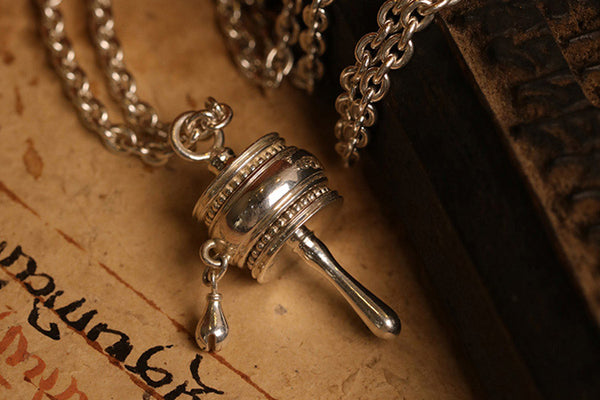
With a prayer wheel pendant you can turn worries into prayers, no matter where you are.
When you wear a prayer wheel necklace, its blessing flows into your being with each turn of the wheel. Spinning it between your fingers in meditation or yoga carries your intention outward.
In daily life, it teaches you to move as the wheel moves. In other words, go with the flow of life, releasing attachments instead of gripping them. In time, it clears your path to awakening by turning your worries into prayer, one spin at a time.
Buddhist necklace meaning: Merit in motion, impermanence, and worries turned to prayers.
Kalachakra Necklace Meaning
The Kalachakra is a sacred Buddhist emblem of time and wisdom. In fact, its very name means "wheel of time." Its intertwining shapes trace the great cycles of the cosmos. To wear this divine symbol is to embrace the eternal dance of life and death.

The Tibetan "wheel of time" worn as a gau pendant.
When you wear a Kalachakra necklace, its blessings rotate through your chakras. This clears blockages and opens you to insight. In meditation and yoga, it lifts you beyond the grip of time and connects you to a higher reality.
In daily life, it brings clarity and calm, teaching you to live fully in the present moment. In the end, the Kalachakra offers the rarest blessing on this page: not more time, but freedom from it. In each fleeting moment, you are reborn.
Buddhist necklace meaning: The wheel of time, cosmic cycles, and freedom from time itself.
Summary
All in all, in our ephemeral world of constant change, a Buddhist necklace is an anchor for the soul. Its weight around your neck is a quiet reminder of your practice as well as your spiritual journey. To wear such an ornament is a noble gesture of genuine faith and hope. It's a statement to the world of your quest for wisdom and enlightenment.
So begin that quest. I invite you to shop our collection of Buddhist necklaces. May you discover the piece that is the light in your darkness and the one that lights your path to awakening.
Frequently Asked Questions
Still have questions? You're in good company. Wearing a Buddhist necklace tends to invite them. From etiquette to blessings to what happens when a pendant breaks, here are the answers our customers most often ask.
Is it disrespectful to wear a Buddhist necklace?
Not when you wear it with care. Across Asia, Buddhists of every tradition wear these necklaces daily. What matters most though is intention. Rather than wear it as an accessory, let it serve as a reminder of Buddhist teachings. That said, treat it with the same respect you have for a close friend, because that's what it is. When you wear it this way, you honor the tradition.
Can I wear a Buddhist necklace if I'm not Buddhist?
Yes. The Buddha offered his teachings to everyone, regardless of their faith. That means, there is no initiation required to wear these pendants. Plenty of people wear one simply for the calm it brings. If the Buddhist necklace meaning speaks to something in you, then that is reason enough.
What is the difference between a Buddhist pendant and a Buddhist amulet?
Often the object is the same, yet the emphasis differs. The Buddhist pendant meaning is mostly about symbolism. For example, maybe the pendant reminds you of a particular Buddhist teaching, a quality, or a way of being. The Buddhist amulet meaning leans more toward blessing and protection. This is especially true in Thailand, where monks consecrate them to guard the wearer. One remembers, the other protects.
Which Buddhist necklace should I choose?
Choose the figure or symbol that will have the biggest impact on your life now. Are you seeking clarity? If so, then Manjushri carries the sword of wisdom. Do you need to feel protected? Acala stands as the one who safeguards. Do you take life too seriously? The Laughing Buddha can bring lightheartedness to your life. Of course, there's no wrong answer here. The piece that keeps drawing your eye is usually the one worth looking into.
How do you treat a Buddhist necklace with respect?
A few simple habits can go a long way. Keep it clean, and never let it touch the floor. When you take it off, store it somewhere elevated. In Thai tradition, practitioners keep these sacred images above waist height. Some wearers remove their necklaces before they take a shower or go to sleep. None of this is complicated. Instead, it's more like mindfulness, practiced through an object.
Do Buddhist necklaces bring good luck?
That depends on what you call luck. Tradition holds that blessed amulets attract fortune and ward off danger. But here is a more grounded view: the Buddhist necklace meaning changes the wearer. A person reminded daily to stay calm, compassionate, and awake tends to make better choices in life. And better choices look a lot like luck. So it comes down to this: the luck it brings is the kind you make.
How do you bless a Buddhist necklace?
Traditionally, a monk consecrates it. They do this by chanting over it, sometimes for hours, to imbue it with blessing. If there isn't a temple nearby then you can do it yourself. Hold the necklace in your hands, set a clear intention, and recite a mantra such as Om Mani Padme Hum. The blessing lives less in ritual perfection than in the sincerity you bring to it.
Is it bad luck to buy a Buddhist necklace for yourself?
Not at all. That is a superstition that belongs to other traditions. Buddhists across Asia have been buying their own amulets for thousands of years. Sometimes they even travel great distances just for a specific piece. More importantly, choosing to buy your own Buddhist necklace is an act of intention. That's because it carries your own resolve. And if you gift one to a loved one instead, it carries your goodwill. Both are potent.
What does it mean if my Buddhist necklace breaks?
A broken necklace is not a bad omen. Folk tradition actually sees it as good news. The amulet broke because it absorbed misfortune that was headed your way. Buddhism sees it through the lens of impermanence. Simply put, nothing lasts, and the necklace just demonstrated its own teaching. Whichever meaning you prefer, the response is the same. Thank the piece, then repair it or retire it respectfully.
Can you wear more than one Buddhist necklace at a time?
You can. In Thai tradition, practitioners often wear three or five amulets at the same time. And they always place the principal figure or symbol at the center. In this light, practicality matters more than superstition. Pendants that clash and tangle make poor companions for sacred images. So, you'll want to layer them so that each necklace hangs freely with its own space.
